9V Battery
A 9V alkaline battery (IEC 6LR61 / ANSI 1604A, PP3 form factor) that delivers a nominal 9 volts from six 1.5V cells stacked in series.
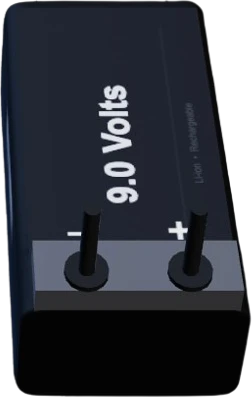
What is the 9V Battery?
The 9V battery is a compact rectangular pack in the standard PP3 form factor, measuring roughly 26mm wide, 48mm tall, and 17mm deep and weighing about 45g. Its most common form uses alkaline zinc-manganese dioxide (Zn/MnO2) chemistry, carrying the IEC designation 6LR61 and the ANSI/NEDA designation 1604A. The '6' in 6LR61 reflects the six 1.5V cells wired in series inside the case, which together produce the nominal 9V output. Power is taken from a polarized snap connector on top, where the smaller terminal is positive and the larger terminal is negative.
Because it is built from small cells, a 9V alkaline pack has modest usable capacity, typically in the range of about 550-600 mAh when discharged slowly to a 4.8V cutoff, with delivered capacity falling sharply at higher currents. Its internal impedance is relatively high (on the order of 1.7 ohms), so terminal voltage sags noticeably under load. This makes the 9V well suited to low-drain, intermittent electronics such as smoke detectors, multimeters, guitar pedals, and small prototypes, and poorly suited to sustained high-current loads.
In Arduino and microcontroller projects the 9V is most often used as a source feeding an onboard regulator rather than a logic rail directly. On an Arduino Uno or Nano it is connected to the barrel jack or the VIN pin, whose recommended input range of 7-12V comfortably accepts 9V, and the board's regulator steps it down to 5V. As a passive power source it is not part of Tinkered's live circuit simulation.
Specifications
- Operating voltage
- 9 V
- Dimensions
- 26 × 48 × 17 mm
Verified from the Tinkered component library.
Circuit requirements
- Nominal output is 9V (around 9.5V fresh), which exceeds the 5V/3.3V logic level of most microcontrollers; route it through a voltage regulator instead of driving a logic rail directly.
- On an Arduino Uno or Nano, feed the battery into the barrel jack or the VIN pin (7-12V recommended input), never into the 5V pin.
- The snap connector's smaller (hex) terminal is positive and the larger (round) terminal is negative; confirm polarity before connecting.
- Usable capacity is only about 550-600 mAh and internal impedance near 1.7 ohms causes significant voltage sag, so the pack is unsuited to motors, servos, or LED strips drawing hundreds of milliamps.
- Add a series fuse or current-limiting resistor where practical; a direct short across the terminals can source enough current to overheat the pack.
Common 9V Battery mistakes
Reversing polarity on the snap connector
The two snap terminals are different sizes for a reason: the smaller hex terminal is positive and the larger round terminal is negative. Swapping them reverse-biases your circuit and can destroy polarity-sensitive parts like ICs and electrolytic capacitors.
Wiring 9V straight to a 5V or 3.3V pin
Applying the full 9V to an Arduino's 5V pin or to a bare 5V/3.3V microcontroller almost always damages it. Send 9V into the barrel jack or VIN so the onboard regulator can drop it to a safe logic voltage, or use an external regulator.
Expecting high current or long runtime
With only about 550-600 mAh of capacity and high internal impedance, a 9V drains quickly and its voltage sags under heavy loads. Motors, servos, and LED strips can cause brownouts that reset the microcontroller, so use a higher-capacity source for those.
Powering motors or servos directly from the 9V
Inductive and high-inrush loads pull the terminal voltage down and can starve the logic supply sharing the same battery. Separate the motor supply, or use a battery pack rated for the peak current the actuator demands.
Leaving the connector exposed near metal
The two terminals sit close together on top of the pack. A loose lead, coin, or foil touching both at once shorts the battery, which heats it rapidly and can rupture or vent it. Insulate unused terminals during storage.
Build with the 9V Battery.
Drop the 9V Battery into a circuit, write firmware, and simulate it in your browser, then deploy to real hardware. All in one editable Tinkered project.