Breadboard (Half+)
A half-size solderless breadboard with 400 tie points for compact circuits and small modules without soldering.
What is the Breadboard (Half+)?
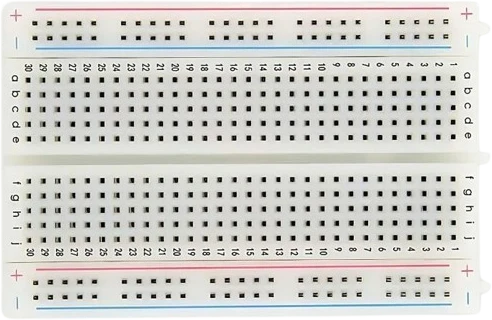
A breadboard is a reusable base for building circuits without soldering. You push component leads and jumper wires into its spring-clip holes, called tie points, and the clips hold the parts and connect them electrically, so a circuit can be assembled and changed in seconds. This half-size board packs the same layout as a full-size one into a smaller footprint, which suits compact builds and single breakout modules.
The holes sit on a 0.1 inch (2.54 mm) grid, the same pitch as through-hole ICs and 0.1 inch headers. In the main area the holes are connected in short columns of five: the five holes in a column are joined, while each column stays separate from its neighbors. A channel runs down the center so a DIP chip can straddle it with each row of pins on its own isolated column.
The strips along both long edges are the power rails. Each rail runs the length of the board and carries one net, typically power or ground. As with full-size boards, the rails may be split in the middle, so jumper the halves together if you need a rail along the whole length.
Specifications
- Tie points
- 400 totalStandard half-size breadboard
- Hole pitch
- 0.1 in (2.54 mm)Standard half-size breadboard
- Terminal strips
- Two halves, columns of 5 connected holesStandard half-size breadboard
- Power rails
- 4 bus strips (2 per side)Standard half-size breadboard
- Center channel
- Isolates the two halves so DIP ICs straddle itStandard half-size breadboard
- Typical size
- about 83 x 55 mmStandard half-size breadboard
Every specification is cited to its source.
Common Breadboard (Half+) mistakes
Forgetting the center channel
The two terminal-strip halves are not connected across the middle channel. A DIP IC is meant to straddle it so each pin sits on its own column. Parts placed expecting a connection across the channel stay open.
Assuming the power rails are one net
On many boards each power rail is split in the middle. If your circuit needs power or ground along the whole board, add a jumper to bridge the two halves of the rail.
Using wire that is too thick or stranded
Thick or stranded wire and heavy leads can spread the spring clips and leave loose, intermittent contacts. Use solid-core jumper wire (typically 22 AWG) and keep leads clean and straight.
Running high current or mains voltage
A breadboard is for low-voltage, low-current prototyping. The clips have real contact resistance and are not rated for high current or mains voltage, so keep them for logic and small-signal work.
More breadboards
Build with the Breadboard (Half+).
Drop the Breadboard (Half+) into a circuit, write firmware, and simulate it in your browser, then deploy to real hardware. All in one editable Tinkered project.