1N4007 Diode
A 1 A general-purpose silicon rectifier rated to 1000 V reverse blocking, in a through-hole DO-41 axial package.
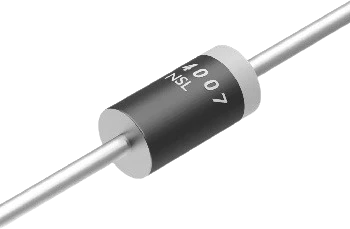
What is the 1N4007 Diode?
The 1N4007 is the highest-voltage member of the 1N400x family of general-purpose silicon rectifier diodes. It carries up to 1 A of average forward current and blocks up to 1000 V in reverse (VRRM), which makes it the default workhorse for mains-derived and general power-supply rectification.
Like any silicon PN diode it conducts only from anode to cathode. The forward drop is near 0.7 V at light load and rises toward the datasheet maximum of about 1.1 V at the full 1 A rating. It can absorb a non-repetitive surge of up to 30 A for a single 8.3 ms half-sine, so it survives inrush and short transient spikes.
It ships in the axial DO-41 (DO-204AL) molded package with a printed band marking the cathode end. It is a standard-recovery rectifier (reverse recovery in the microsecond range), so it is intended for 50/60 Hz line-frequency rectification and flyback protection rather than high-speed switching.
Specifications
- Forward voltage
- 0.7 V
- Dimensions
- 5.2 × 2.7 × 2.7 mm
Verified from the Tinkered component library.
Circuit requirements
- Polarity is fixed: conventional current flows anode to cathode, and the printed band marks the cathode. Install it backwards and it blocks instead of conducting.
- As a flyback (freewheeling) diode across an inductive load such as a relay coil, motor, or solenoid, wire it in parallel with the coil with the band (cathode) toward the positive supply so it clamps the reverse voltage spike at turn-off.
- For reverse-polarity protection, place it in series with the supply feed; downstream circuitry is protected at the cost of the forward drop.
- Keep average forward current at or below 1 A, and derate above 75 C ambient per the datasheet derating curve; adequate lead length also helps carry heat away.
- Budget for the forward voltage drop (roughly 0.7 V, up to about 1.1 V at 1 A) when the diode sits in a low-voltage rail, both for the lost voltage and the power it dissipates.
- Do not use it for switch-mode or PWM rectification; its microsecond-scale recovery makes it inefficient at high frequency, where a Schottky or fast-recovery diode belongs.
Common 1N4007 Diode mistakes
Installing it backwards
The diode is polarized and the band denotes the cathode. Reversed, it blocks current when used as a rectifier, or fails to clamp when used as a flyback diode. Always check the band orientation against the schematic.
Using it for high-frequency switching
The 1N4007 is a standard-recovery rectifier with reverse recovery in the microsecond range. In a switch-mode supply or fast PWM path it runs hot and wastes power. Use a Schottky or fast-recovery diode there instead.
Ignoring the current rating and derating
The 1 A average rating assumes reasonable lead length for heatsinking and derates above 75 C ambient. Running near 1 A in still, hot air will overheat the part.
Treating it as an ideal switch
It always drops about 0.7 V to 1.1 V while conducting. On a 5 V or 3.3 V rail that loss, and the heat it produces at higher current, can be significant.
Confusing it with the rest of the 1N400x family
Every 1N4001 through 1N4007 shares the same 1 A DO-41 body and looks identical; only the printed part number sets the reverse voltage (1N4001 is 50 V, 1N4007 is 1000 V). Do not assume an unmarked part from the bin is a 1N4007.
More passives & discretes

resistor-220220Ω Resistor
Custom resistance values supported

resistor-1k1kΩ Resistor
Custom resistance values supported

resistor-10k10kΩ Resistor
Custom resistance values supported
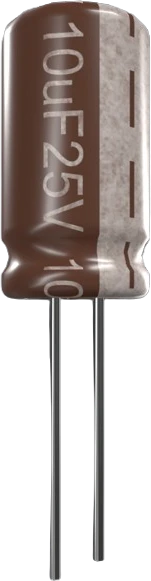
capacitor-ceramic100nF Ceramic Capacitor
Custom capacitance values supported
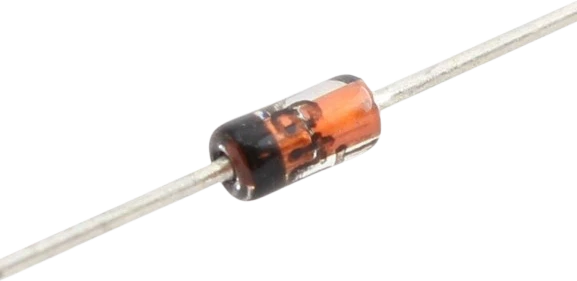
diode-1n41481N4148 Diode
Fast switching diode
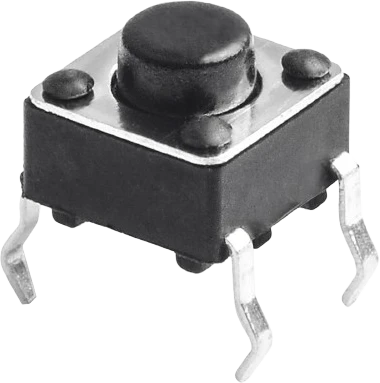
push-buttonPush Button
Momentary digital input
Build with the 1N4007 Diode.
Drop the 1N4007 Diode into a circuit, write firmware, and simulate it in your browser, then deploy to real hardware. All in one editable Tinkered project.