2N3904 Transistor
General-purpose NPN bipolar junction transistor for small-signal amplification and low-power switching, rated to 40 V and 200 mA in a TO-92 package.
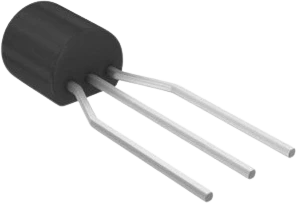
What is the 2N3904 Transistor?
The 2N3904 is one of the most widely used general-purpose NPN bipolar junction transistors (BJTs). It is a silicon epitaxial planar device built for small-signal amplification and low-power switching, and its direct PNP complement is the 2N3906. It ships in the through-hole TO-92 case, which makes it a staple of breadboards and hobby circuits.
As an NPN BJT, a small current flowing into the base controls a much larger current from collector to emitter. The part offers a DC current gain (hFE) of roughly 100 to 300 at a collector current of 10 mA, with a transition frequency of at least 250 MHz. It handles up to 200 mA of continuous collector current and a collector-emitter voltage (VCEO) of 40 V, with total device dissipation of 625 mW.
In the TO-92 package, holding the part with the flat face toward you and the leads pointing down, the pins read Emitter, Base, Collector from left to right. A low saturation voltage (about 0.2 V at 10 mA) and high gain make it a common choice for driving LEDs, small relays, and other logic-level loads from a microcontroller pin.
2N3904 Transistor pinout
| Pin | Function | Type |
|---|---|---|
E Emitter | Passive | Passive |
B Base | Analog | Digital input |
C Collector | Passive | Passive |
Specifications
- Dimensions
- 4.5 × 4.5 × 3.5 mm
Verified from the Tinkered component library.
Circuit requirements
- Always place a base resistor in series with the base when switching. The base-emitter junction behaves like a forward-biased diode, so driving it directly from a 5 V pin lets the current run away. A 1k-10k resistor is typical for a logic-level drive.
- Wire it as a low-side switch: emitter to ground, the load between the positive supply and the collector, and the base driven through its resistor. The load conducts only when the base is pulled high.
- Respect the 200 mA continuous collector current limit and the 625 mW dissipation limit. The 2N3904 cannot drive most DC motors or high-current loads directly; use a MOSFET or a dedicated driver for those, or keep the 2N3904 as the small-signal stage that switches a larger device.
- Add a flyback (freewheeling) diode across any inductive load, such as a relay coil or small motor, to clamp the voltage spike produced when the transistor turns off.
- Stay within the absolute maximum ratings: keep collector-emitter voltage under the 40 V VCEO limit and never reverse-bias the base-emitter junction beyond its 6 V VEBO rating.
Common 2N3904 Transistor mistakes
Driving the base without a resistor
Because the base-emitter junction acts like a forward-biased diode, connecting the base straight to a 5 V pin lets base current climb uncontrolled and can damage the transistor or the driving pin. Always add a series base resistor (commonly 1k-10k for logic-level control) to set the base current.
Assuming the pinout matches other TO-92 parts
With the flat face toward you and leads down, the 2N3904 reads Emitter, Base, Collector from left to right. Popular European parts such as the BC547 use the reverse order (Collector, Base, Emitter), so swapping one for the other without re-checking the pins connects the device backward.
Expecting it to drive a motor or heavy load
Collector current is capped at 200 mA and dissipation at 625 mW. Motors, high-power LED strips, and large relays exceed those limits. Use a MOSFET or a purpose-built driver, and let the 2N3904 handle only the small-signal switching.
Omitting a flyback diode on a coil
When the transistor switches off an inductive load, the collapsing magnetic field produces a large voltage spike that can exceed the 40 V VCEO rating and destroy the part. Place a reverse-biased diode (such as a 1N4148 or 1N4007) across the coil.
Wiring it like a PNP
The 2N3904 is NPN, so the emitter goes to ground and it turns on when the base is pulled high. Its complement, the 2N3906, is PNP and switches the opposite way; mixing them up leaves the load stuck permanently on or off.
More passives & discretes

resistor-220220Ω Resistor
Custom resistance values supported

resistor-1k1kΩ Resistor
Custom resistance values supported

resistor-10k10kΩ Resistor
Custom resistance values supported
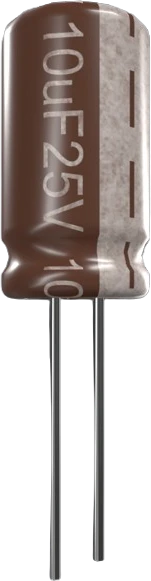
capacitor-ceramic100nF Ceramic Capacitor
Custom capacitance values supported
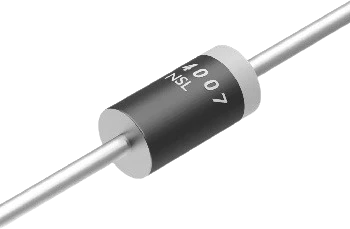
diode-1n40071N4007 Diode
General-purpose rectifier
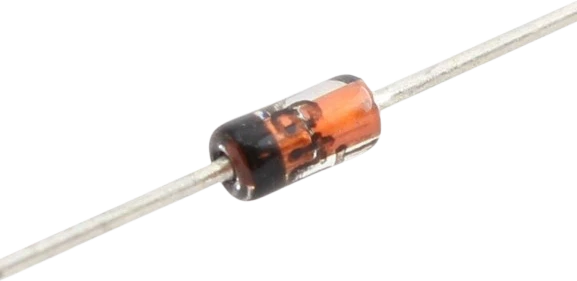
diode-1n41481N4148 Diode
Fast switching diode
Build with the 2N3904 Transistor.
Drop the 2N3904 Transistor into a circuit, write firmware, and simulate it in your browser, then deploy to real hardware. All in one editable Tinkered project.