2N3906 Transistor
General-purpose PNP bipolar transistor in a TO-92 package, rated 40V and 200mA for low-power switching and small-signal amplification.
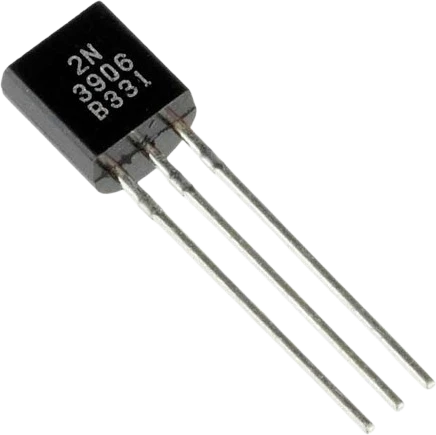
What is the 2N3906 Transistor?
The 2N3906 is a general-purpose PNP bipolar junction transistor housed in a plastic TO-92 case. It is intended for low-power switching and small-signal amplification, and it is the PNP complement to the popular 2N3904 NPN. The verified specs cap the collector-emitter voltage at 40V, and the ON Semiconductor datasheet rates continuous collector current at 200mA with total device dissipation of 625mW at 25C (derating 5.0mW/C above that).
Being a PNP device, the 2N3906 conducts when its base is pulled roughly 0.7V below the emitter, which forward-biases the base-emitter junction. That makes it a natural high-side switch: the emitter sits at the positive supply and the transistor turns the load on when the base is driven low. DC current gain (hFE) typically falls between 100 and 300, and the transition frequency is about 250MHz.
With its modest 200mA and 625mW ceilings, the part suits driving indicator LEDs, small relays through a coil, level shifting, and general signal switching. For motors, high-current loads, or anything approaching those limits, reach for a higher-power transistor or a MOSFET instead.
2N3906 Transistor pinout
| Pin | Function | Type |
|---|---|---|
E Emitter | Passive | Passive |
B Base | Analog | Digital input |
C Collector | Passive | Passive |
Specifications
- Dimensions
- 4.5 × 4.5 × 3.5 mm
Verified from the Tinkered component library.
Circuit requirements
- Wire it as a high-side switch: emitter to the positive supply, collector to the load, and the load returns to ground. The transistor conducts when the base is pulled below the emitter.
- Always place a current-limiting base resistor (commonly 1k-10k) between your drive signal and the base. A bare base connection lets base current run unchecked and destroys the junction.
- Turn the device ON by pulling the base LOW relative to the emitter, and OFF by letting the base rise to the emitter voltage. This is the opposite of an NPN, which turns on with a HIGH base.
- Respect the 5.0V emitter-base (VEBO) limit; do not reverse-bias the base-emitter junction beyond that.
- Keep collector current at or below 200mA and dissipation under 625mW at 25C, derating for higher temperatures.
Common 2N3906 Transistor mistakes
Wiring it like an NPN
The 2N3906 is a high-side, PNP part: the emitter goes to the positive supply, not to ground. Grounding the emitter and expecting NPN behavior means it will never switch the load correctly.
Driving the base HIGH to turn it on
A PNP conducts when the base is pulled LOW relative to the emitter. If your logic drives the base HIGH toward the supply, the transistor stays off. Invert your control logic compared to an NPN.
Omitting the base resistor
Connecting the base directly to a driving pin lets base current spike well past safe levels and cooks the base-emitter junction. A series resistor (typically 1k-10k) sets the base current.
Swapping the E and C pins
On the TO-92 body with the flat face toward you and leads pointing down, the pins read Emitter, Base, Collector from left to right. Reversing emitter and collector kills gain and can damage the part.
Overloading a small-signal part
The 200mA and 625mW limits are easy to exceed. Trying to drive a motor or other heavy load directly will overheat and destroy it; use a power transistor or MOSFET for those loads.
More passives & discretes

resistor-220220Ω Resistor
Custom resistance values supported

resistor-1k1kΩ Resistor
Custom resistance values supported

resistor-10k10kΩ Resistor
Custom resistance values supported
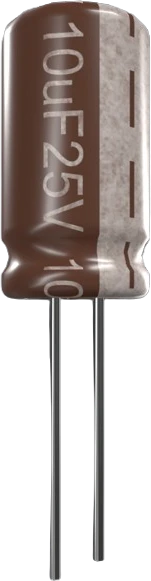
capacitor-ceramic100nF Ceramic Capacitor
Custom capacitance values supported
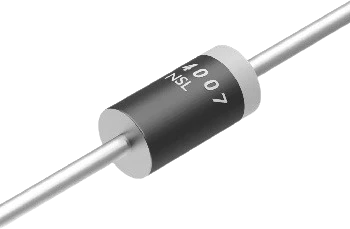
diode-1n40071N4007 Diode
General-purpose rectifier
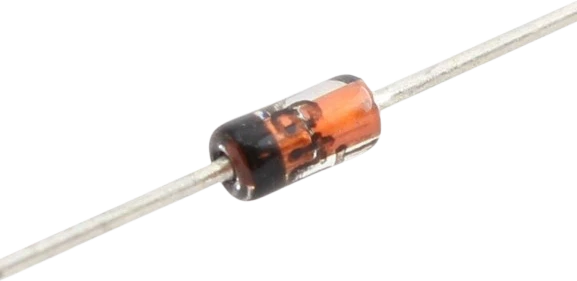
diode-1n41481N4148 Diode
Fast switching diode
Build with the 2N3906 Transistor.
Drop the 2N3906 Transistor into a circuit, write firmware, and simulate it in your browser, then deploy to real hardware. All in one editable Tinkered project.